“How much should we put into Google to attract patients?” The question arrives early, sometimes before anyone has seen the website. Wanting a number makes sense, but the budget needs a few answers around it: which service is advertised, where the clinic is, what a visitor finds after clicking and who handles the enquiry. Without those details, a monthly amount can sound precise while describing surprisingly little of the actual commission.
This guide prepares a Spain-based aesthetic clinic’s Google Ads investment for 2027. Written on 19 October 2026, it uses current documentation and an original economic exercise. Example amounts are illustrative, before VAT; they do not announce LTM fees, future click prices or expected results. The aim is to help you request a proposal, understand its costs and identify the information needed to decide whether the campaign deserves further work and investment.
Separate the costs before choosing an investment
Money allocated to Google pays for ad distribution. Management fees pay for the team’s work: preparing and reviewing campaigns, analysing observations and coordinating changes. There may be initial setup and a separate page or measurement project. A useful proposal identifies those items, describes what each includes and makes the delivery recognisable to the centre. The figures should correspond to work somebody is responsible for doing, with its exclusions and dependencies recorded.
Our Google Ads service for aesthetic clinics defines the commission around that separation. LTM’s published pricing places campaigns within a tailored scope, with media paid to the platform. The specific quote must confirm management, preparation and production. A social or SEO retainer alone does not establish that advertising work is commissioned, even when the teams coordinate. Ask the proposal to show how those contributions relate to each other and who owns each task.
Account, structure, ads and agreed measurement.
Reviews, analysis and coordination.
The amount assigned to distribution on Google.
A page or integration, if separately commissioned.
Imagine a first quarter with €1,200 of preparation, €450 a month of management and €900 a month allocated to media. The calculation is €1,200 + €1,350 + €2,700 = €5,250. It assumes three full monthly periods, one location, one language and a usable existing page. A new website, new photography and bespoke connections are excluded. These assumptions explain a budget rather than describing an agency offer or an actual client commission.
Ask how spending is controlled too. Google distinguishes an average daily budget from spending limits; expenditure need not be identical each day. The manager should explain the chosen settings, their limits and the effect of changes to budget or period. Identify who approves increases and record each change’s amount, date and reason. That provides a shared reference when the centre reviews actual spending against the agreed allocation.
A first campaign needs a recognisable offer and destination
This exercise focuses on Google Search campaigns, one part of Google Ads. Preparation begins with a service the clinic provides and can accommodate, a real location and searches worth investigating. Review available history, market terms and the complete route to reception. A first commission might focus on one service area to keep decisions manageable. Its selection should follow the centre’s circumstances rather than assuming every service needs its own campaign from the outset.
The landing page needs to correspond to the ad. Somebody looking into a service should find reviewed information, the responsible team, location and a clear contact route. A general homepage may be insufficient if it requires a journey around the whole site to find those details. The aesthetic clinic website features guide helps review that destination before buying more visits. Define any required page work in the commission so it has an owner and delivery date.
Nuriia Akhmetova’s New Vision redesign on Behance combines introduction, services, portrait and mobile adaptation. It helps examine the materials involved in a page and discuss composition. The image does not demonstrate advertising performance or represent LTM work. Your campaign needs its own destination, checked with the clinic’s actual information. Use the reference to make design decisions more concrete, while assessing the functioning of your page through an agreed review rather than through the reference’s appearance.
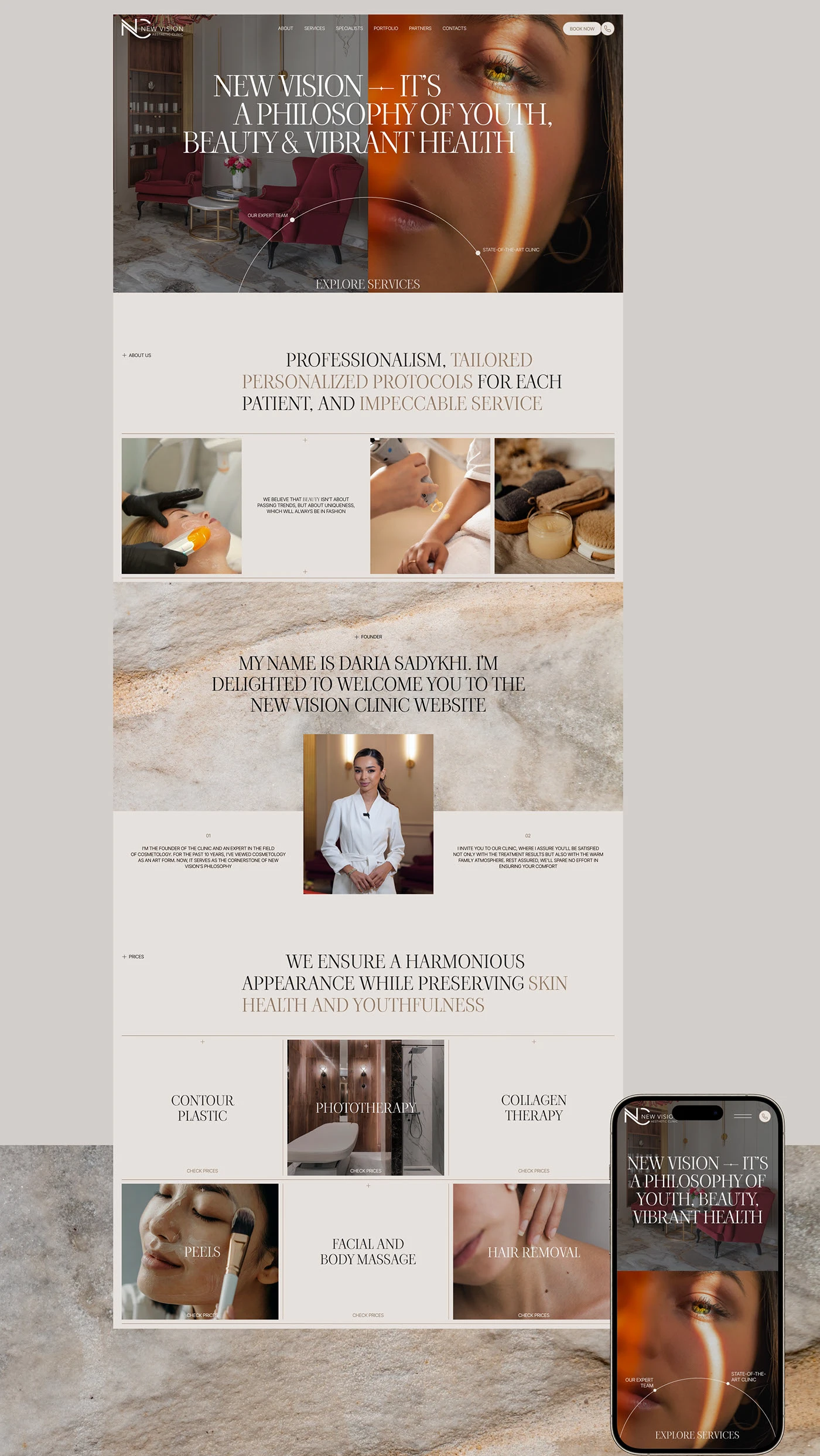
Before launch, rehearse from a phone: enter through the intended page, understand the offer and send an identified test request. Check what arrives and who receives it. Where booking ends in another tool, review that step as well. The proposal should say who corrects the problems found. Advertising depends on that journey as well as decisions inside the account. A clear testing procedure lets both teams recognise what is ready and what still needs work.
Cost per enquiry, booking and attendance are different calculations
A received enquiry expresses interest; a confirmed appointment requires agreement; attendance establishes that the visit happened. Cost changes with the stage used as the denominator. Agree definitions before reading the report and avoid counting every message in one conversation as a new enquiry. The centre should be able to review what the total represents and which requests fall outside the advertised service or area. Keep those distinctions visible when comparing different campaigns or periods.
Continue with a month after setup in the exercise. Assume actual media spend of €900 and management of €450. Reception validates thirty unique enquiries attributed to the campaign, twelve confirmed appointments and nine attendances within the reviewed group. These fictional results demonstrate division, rather than providing a forecast or benchmark. The monthly calculation excludes the initial €1,200; the earlier quarterly budget includes it. State that difference before comparing the figures with a broader cost assessment.
| Example stage | Media only: €900 | Media and management: €1,350 |
|---|---|---|
| 30 unique enquiries | €30 per enquiry | €45 per enquiry |
| 12 confirmed appointments | €75 per appointment | €112.50 per appointment |
| 9 attendances | €100 per attendance | €150 per attendance |
The costs describe this exercise using two explicit spending bases. They exclude care delivery costs, new sales, repeat business and margin. Assessing total investment for another period requires its corresponding costs and enough time to review appointments. A recent campaign may have open enquiries. Comparing its attendances with a settled month without explaining that difference weakens the conclusion. Preserve the group and review date so the clinic can understand what has been counted and what remains outstanding.
Cost per enquiry should not become the only criterion. Review whether the advertised service matches requests, availability exists and reception can respond. An inexpensive enquiry outside the area may offer little to the centre. The guide to enquiries that do not become appointments develops those losses and the coordination needed to understand them before increasing spend. It also helps distinguish campaign issues from gaps in the route after the initial request arrives.
Review ads, pages and targeting before committing to launch
Google’s healthcare and medicines policy sets restrictions by content and location. Review ads, intended searches and destinations. Requirements for one activity do not automatically apply to every clinic. The responsible team must check the particular service and applicable conditions before settling the launch. A proposal should recognise that review as part of preparation, with any necessary work assigned.
Google treats certain health categories, including invasive procedures, as sensitive in its personalised advertising policy. This restricts certain advertiser-created audiences. A proposal should not include remarketing by default without assessing eligibility. The agency needs to explain which options fit the commission and review them if advertised content changes. Preparing a campaign does not guarantee approval.
The clinic provides professional information and validates messages describing its care. The campaign team prepares copy and destinations within that framework. Where a piece needs changes, identify what is being reviewed and how it affects the schedule. Request a review of the complete page too: restrained ad copy can still lead to a destination telling a different story. The review needs to follow the journey the visitor will see, with consistent information across its stages.

Likha, WONDR’s digital project featured on Awwwards, shows portrait, colour and typography creating a shared presentation. It supports a visual direction discussion rather than demonstrating ad approval or results. Your campaign needs original materials and reviewed messages. When image and information serve the same brief, continuity between ad, page and first conversation becomes easier to maintain. Include that relationship in the design review so visual choices have a purpose within the journey.
Measure something reception can recognise
Google Ads conversion measurement depends on configured actions. Before interpreting a total, ask whether it counts taps, submitted forms or another verified action. A telephone click does not establish an answered call. Configuration should describe the distinction and be tested against the intended action, avoiding duplication through two sources. A meaningful report needs that shared definition before it can support a discussion of campaign performance.
The centre’s records add another layer: unique enquiries, answered contact, appointments and attendance. Agree how they relate to a campaign where evidence supports attribution, retaining unknown origin where it does not. Marketing reporting can use totals and organisational reasons without including care records. Any additional connection between tools needs a specific review of its purpose, data and conditions before implementation. Define that work separately rather than assuming a reporting dashboard establishes a complete appointment history.
What the campaign configuration records.
A unique request the centre can verify.
Stages checked with reception.
Bring actual spend, implemented changes, observed searches and verifiable contacts to each review. Explain what is still needed for a decision. A failing destination requires correction; unsuitable enquiries call for reviewing message and scope; insufficient data needs to remain visible in the report. The Google Ads and Instagram Ads comparison helps assess the channel where the question extends beyond adjusting an existing campaign. Keep the question clear enough to identify the next useful piece of work.
A first quarter with decisions and named owners
The 2027 calendar can begin with preparation, approval and an agreed first test. The following period reviews published work, measurement and handled conversations. Quarterly evaluation decides what to continue, correct or extend according to available evidence. These are work milestones without a promised profitability date. The centre should recognise what has been delivered even where information cannot yet answer every commercial question. Record the reason for the next decision alongside the work it commissions.
Identify the clinic’s account, billing and each provider’s access. If the team changes, history needs to remain reviewable and the next owner needs configuration and outstanding tasks. The agency switching guide develops that handover. Clarify these arrangements while preparing the first commission, when both parties can describe what a workable delivery requires.
Odyssée, by Nightjar and featured on Awwwards, presents a recognisable website direction. It offers a reference for maintaining coherence during page changes and new content. The image does not establish campaigns or results delivered by LTM. Destination design and subsequent maintenance need an owner so advertising does not depend on a correction neither supplier expected to make. Include those arrangements in the commission, especially where the website and campaigns are handled by different teams.

Tell us which service you want to introduce in 2027, where the clinic is and how enquiries are handled today. Existing campaigns provide a starting history through the access we agree. Lead The Mood can prepare a commission identifying setup, management, media and destination. You can then choose an investment to test and the information used to review its next steps, without purchasing a patient count written before anybody has understood your centre.