Two SEO proposals arrive. One offers “monthly optimisation”; the other lists an impressive number of keywords. Both have a retainer and an upward chart. It is harder to establish who will write a service page, fix a contact problem or explain progress to the clinic director. A quote becomes useful when you can recognise the work behind it. The chart can have its turn once those questions have answers.
Planning aesthetic clinic SEO for 2027 means reviewing cost, delivery and measurement together. This guide was prepared on 19 October 2026: commercial references reflect what is published today, and a 2027 commission must confirm its own terms. It includes an annual budget exercise, a possible first quarter and a way to review progress. These are tools for comparing proposals for a Spain-based clinic, with room to adapt the brief to your organisation.
What a monthly SEO retainer actually buys
Clinics start from different positions. A recently launched website might have sound pages but little explanation of its services. Another has years of articles, several languages and forms that nobody has tested recently. A third needs to coordinate two locations. Before discussing the monthly article count, review what a visitor can currently find, which searches matter to the centre and what work prevents the website from addressing them. The starting position should inform the commission.
An audit should lead to priorities, owners and deliveries. When it recommends a technical correction, ask whether the supplier implements it or sends instructions to your developer. For content, distinguish research, interviews, writing, review and publication. Our SEO service for aesthetic clinics defines those responsibilities so the centre can identify what it is delegating. We also establish which information the clinic must provide and who can approve it before anything is published.
What is happening and what needs attention first.
Who changes, writes, publishes and checks.
What is observed and what happens next.
A retainer may include ongoing implementation or a limited amount of advice. Either arrangement can work when the clinic has the necessary people. A proposal needs clarification when it blends them: extensive recommendations and nobody assigned to bring them onto the site. Request a sample monthly delivery and identify dependencies on your designer, reception team or the professional responsible for reviewing care-related information. That discussion makes the practical workload much easier to understand.
A starting price, a specific quote and the annual cost
As a current reference, Lead The Mood publishes clinic SEO from €690 a month. This is a starting price checked in October 2026. Your proposal must confirm the fee, taxes, allocation and conditions. It does not establish that every website, language or group of locations fits the same retainer, or announce a 2027 fee before it has been agreed. The amount needs to be read alongside the work.
For comparison, separate initial preparation from recurring delivery. The following exercise assumes one location, an existing single-language website and a clinic contact who supplies information and approves content. It allocates €1,800 to diagnosis and initial preparation, followed by €1,120 a month for an implementation programme. These hypothetical amounts are before VAT. They demonstrate budget structure rather than introducing an LTM package or claiming to represent average market prices. A real proposal needs its own detailed scope.
| Example item | Assumption | Before VAT |
|---|---|---|
| Initial preparation | Review, priority map and agreed setup. | €1,800 |
| Ongoing delivery | €1,120 × twelve monthly payments. | €13,440 |
| Twelve-month total | Initial preparation plus twelve retainers. | €15,240 |
The calculation assumes twelve full months of service. An opening partway through the year needs a different period. It excludes advertising, new photography, a new website, additional languages and substantial development. It also does not set a minimum contract: duration, reviews and exit arrangements are agreed separately. Establish whether initial preparation is already included in the monthly charge to avoid counting it twice. Then ask each supplier what delivery its proposed fee can sustain.
A useful comparison shows extras and dependencies too. Where the website needs rebuilding, that project deserves its own brief; the 2027 aesthetic clinic website cost guide helps prepare it. For additional languages, identify the pages and review of each version. If your team implements some recommendations, reserve its time. That contribution may not appear on the agency invoice, but somebody must still do it, check it and keep the project moving.
For the annual budget, identify who approves additional work and how it is estimated before implementation. A new service area, another location or a different booking platform may change the commission. A short record of the reason, delivery, amount and approval keeps those decisions from disappearing into email. It also helps distinguish the regular programme from projects added during the year when the total investment is reviewed.
A first quarter that leaves published work behind
Planning the year lets you agree a sequence. One possible first quarter combines a technical review, improvements to two service pages, a review of one clinic page and an update of the centre’s Google information. This is an example commission, rather than a quantity every clinic should purchase. Discovery may recommend spending more time on technical corrections or developing information that is currently missing. The brief should remain connected to those findings.
The first month can gather access, materials and available data, test contact and order the tasks. The second can focus on writing, approval and publication. The third reviews implementation and newly identified questions. Stages may overlap when the team is ready. A quarterly meeting helps adjust delivery without turning its date into a promise of rankings or appointments. What the clinic should be able to review is the work completed and the reasoning for its next priorities.
Review the foundations and deliver initial improvements.
Evaluate pages and develop identified needs.
Review services, materials and changes at the clinic.
Evaluate the year and prepare the next commission.
GEMA Centres Mèdics, a Code Barcelona group project, provides a reference for relationships between centres, specialties and practitioners. Its information structure is the point of interest here. This is not an SEO results case, and the table’s amounts do not describe that project. A clinic with fewer services needs a different architecture, but still needs to explain who practises, where they are based and how somebody can request information.

Allow time for approval. A well-written page may still need information from the centre. Establish who reviews care-related details, how comments are returned and what happens when the described service changes. A plan becomes more useful when it includes that work. If approval takes three weeks, the publication schedule needs to acknowledge it before promising a dependent delivery. The agency and clinic can then arrange their contributions around a realistic sequence of reviews.
Pages, local presence and content connected to your work
Topic selection should begin with the offer, reception conversations and observable searches. A service page explains what the centre provides using reviewed information. A guide can answer an earlier question and lead to that page. Publishing more makes sense when there are distinct needs worth addressing. Our local SEO guide for aesthetic clinics develops that architecture and its relationship with Google Maps, providing a separate reference for website organisation before you decide what ongoing work to commission.
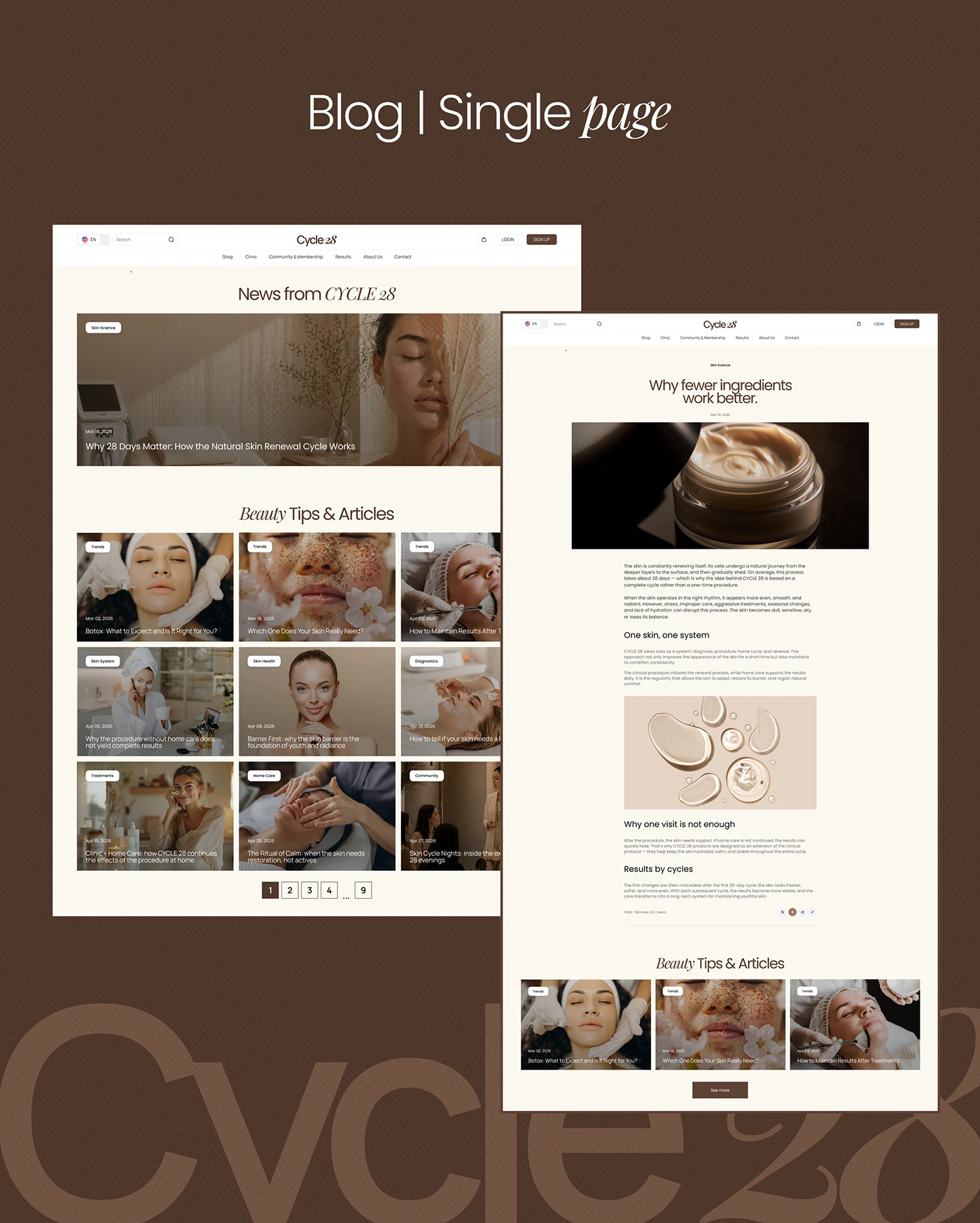
Cycle 28, published on Behance by Tania Syoma, Julia Tarna and Varvara Barva, presents a proposed article listing and reading layout. It helps discuss how a content library could be presented with a consistent design. Your clinic still needs to decide which information deserves that space and who can prepare it. The visual reference does not demonstrate traffic or patient acquisition results. It offers material for the design discussion, rather than evidence of search performance.
Local presence requires accurate information and maintenance. Google explains that local results consider relevance, distance and prominence. A commission can review information, pages and consistency between destinations; it cannot purchase a fixed Maps position. With several locations, identify which information, content and review belongs to each centre. Show that additional work in the quote alongside the coordination needed to keep it current. Different locations need their own accurate details.
For 2027, also ask what an “AI visibility” line item means. Google states that its AI features in Search retain SEO fundamentals and do not require special files or markup. Any additional proposal should describe tasks and measurement. Reviewing information or investigating new searches can be a concrete commission. An acronym alone leaves too many unanswered questions about what the clinic receives and how the work will be assessed.
A report should help decide the next month’s work
Begin the meeting with what can be verified: published changes, checked tasks and outstanding materials. Then review the pages that have been worked on. Search Console provides impressions, clicks and queries. Distinguish brand searches from other searches and compare equivalent periods. Increased visibility for the centre’s name may have a different explanation from new discovery of its services. The report should make those differences understandable before drawing a commercial conclusion.
Contacts need another check. Tapping a telephone link records an action; an answered call, a received enquiry and a confirmed appointment are different events. Agree what is recorded, who validates it and which channel can be attributed reliably. Reception can supply aggregate booking and attendance counts without sending care-related information into marketing tools. When the source is unknown, retain that limitation in the report rather than assigning a convenient origin to every conversation.
These layers support decisions: review a page appearing for an unsuitable need, improve a confusing contact journey or continue an editorial family reaching relevant readers. Early impressions help investigation but do not establish profitability by themselves. Ask the agency to explain what it has learned and what it will change next. The report then has a purpose when the graph rises and when it suggests that the work needs a different direction. Both situations deserve an explanation.
Keep the starting data and record publication dates, campaigns and important changes at the centre. That context will help interpret the quarterly review. It does not turn coincidence into causation, but supports better questions and a next intervention whose implementation can be checked.
Agree a commission the team can sustain
Design belongs in that continuity. Odyssée, by Nightjar, presents a distinctive website direction featured on Awwwards. It offers a reference for maintaining a recognisable presentation as the site grows. Editorial maintenance should allow new content to sit coherently alongside existing pages, with mobile reading and contact checked. This reference is not presented as an SEO results case or a commercial relationship with LTM. Its role here is to inform the discussion about design and ongoing publication.

Before starting, record deliveries, exclusions, contacts, reviews and continuation terms. Establish the clinic’s access to accounts and delivered content too. The guide to choosing a marketing agency helps compare suppliers; the agency switching guide develops handover where a previous team is involved. These arrangements are easier to discuss while the conversation is calm and both parties can explain what they need for a workable relationship.
Tell us what you want to prepare for 2027: website, services, locations, languages and the team available for review. Lead The Mood can define priorities with the Code Barcelona group’s strategy, design and development team. The proposal should make the first quarter’s work recognisable, show the cost of the agreed period and identify the information used to decide what follows. With those things on the table, the retainer starts to say something useful.